
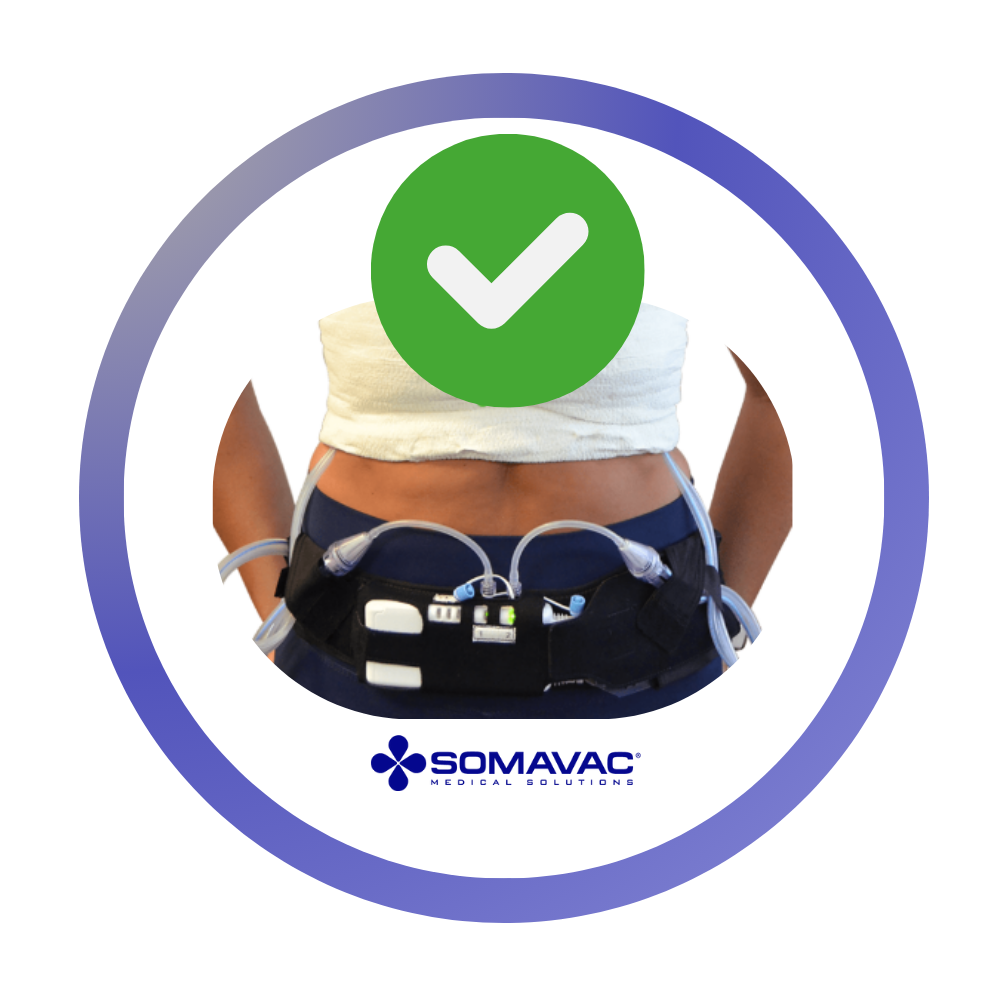
Modernizing surgical recovery with a proven solution that shortens drain duration, simplifies care, and improves satisfaction for patients and providers alike.
Fifty years without innovation
Surgical drainage is one of the last parts of the operating room that never modernized. The Jackson-Pratt bulb has been the standard since 1971: a hand-squeezed reservoir, safety-pinned to a patient’s clothing, that has to be stripped, emptied, measured, and recorded three or four times a day, often by a patient who is still in pain, and often for weeks.
The problem isn’t only the burden. It’s the physics. A squeezed bulb starts near its target vacuum and then loses it as fluid enters, so suction fades between every manual reset. Fluid that isn’t evacuated collects in the space where tissue used to be. That collection is called a seroma, and it keeps drains in longer and raises the risk of complications.
What smart surgical drainage does differently
SOMAVAC® replaces the bulb with a small, battery-powered pump worn on a belt under clothing. A sensor monitors pressure and the pump holds a continuous −100mmHg, not a curve that decays between squeezes, but a constant, deep tissue negative pressure delivered directly into the wound space.1
- Continuous, sensor-controlled suction. The pump maintains −100mmHg around the clock instead of fading between manual resets.
- A fully closed system. Up to four surgical drains connect through one-way connectors, minimizing exposure to infectious material.
- Non-touch disposal. Fluid collects in a marked bag for easy measurement and disposal: no stripping tubes, no handling fluid, no safety pins.
- Worn, not carried. As flat as a phone, on a belt under clothing, so patients can move normally while they heal.
Because fluid keeps leaving the body, tissue layers stay in apposition and heal together, and the drains come out sooner.
Remove drains sooner
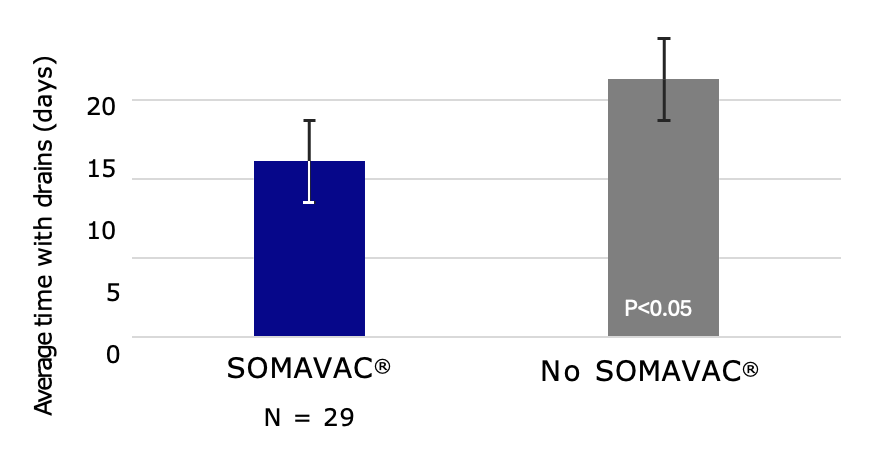
In a prospective mastectomy study, patients using SOMAVAC® averaged 11.4 days to drain removal, as early as 8.3 days, compared with 16.3 days on JP bulbs. That is a 30% reduction in drain duration, or nearly five fewer days living with drains.1
The Hecox study reported an 86% reduction in return to the OR (2% versus 14% with JP bulbs, p=.05, n=49) and a mean patient satisfaction of 9.27 on the Likert scale (p=0.008, n=49).2
Easier to Use Than a Thermometer1,6
Patient-reported • 0 to 100 scale • p=0.0008 • Data on file
46.7
JP Bulbs
93.2
SOMAVAC
82
Thermometer
78
Inhaler
Rated “best imaginable” on SUS scale. Thermometer & Inhaler: Kortum & Peres (2015). Data on file.
Patients rated SOMAVAC® 93.2 on the System Usability Scale, “best imaginable” territory, and well above a thermometer (82) or an inhaler (78), against 46.7 for JP bulbs.1,3
What it means for a practice
Shorter drain duration and a closed, self-managing system change the weeks after surgery for everyone involved: fewer drain-related calls and office visits, better compliance, earlier mobility for physical therapy, and a recovery patients are willing to talk about. SOMAVAC® is FDA-cleared for seroma prophylaxis in plastic and general surgery, including mastectomy, breast reconstruction, hernia repair, abdominoplasty, and panniculectomy.
Download the Clinical Data (PDF)References
- Data on file. Prospective mastectomy study, N=45, p=0.003.
- Hecox study, SSPRS 2026. n=49.
- Thermometer and inhaler SUS benchmarks: Kortum & Peres (2015).