SOMAVAC® was featured in Essential Advantage by Essentially Women, highlighting the revolutionary SOMAVAC® SVS and its potential to improve the post-surgical recovery experience for breast cancer patients.
Essentially Advantage reaches the providers who serve women after breast surgery: the mastectomy fitters, DME suppliers, and women’s health specialists who see patients through recovery. The feature introduced that audience to the SOMAVAC® Sustained Vacuum System and the problem it was built to solve.
The part of recovery that never changed
Since 1971, patients have gone home from breast surgery with Jackson-Pratt bulb drains: hand-squeezed reservoirs, often safety-pinned to clothing, that have to be stripped, emptied, measured, and recorded three or four times a day, frequently for weeks, and frequently by someone still in pain. A squeezed bulb also loses its vacuum as fluid enters, so suction fades between every manual reset.
What the SOMAVAC® SVS does
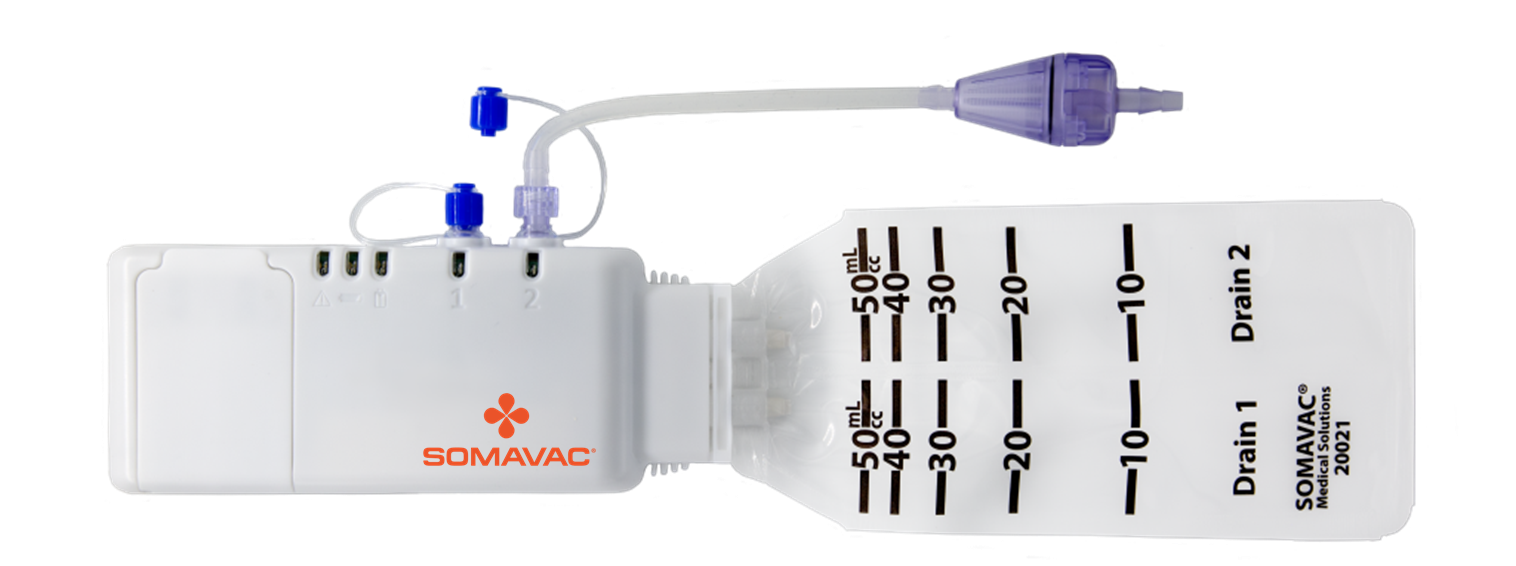
The SOMAVAC® Sustained Vacuum System replaces the bulb with a small, battery-powered pump, as flat as a phone, worn on a belt discreetly under clothing. A sensor holds continuous negative pressure at −100mmHg, delivering deep tissue negative pressure therapy directly into the wound space rather than at the surface.
- Up to four surgical drains connect through one-way connectors in a fully closed system
- Fluid collects in a marked bag for precise measurement and non-touch disposal
- No squeezing, no milking the tubing, no safety pins
- Patients stay mobile while they heal
Because suction is continuous rather than fading between resets, fluid keeps leaving the body and tissue layers heal together. In a prospective mastectomy study, patients had their drains removed up to 30% sooner: 11.4 days on average, versus 16.3 days with JP bulbs.1
Why it matters to this audience
Providers in the Essentially Women network are often the ones patients call when recovery gets difficult. A drainage system patients can manage without handling fluid, and that comes off sooner, changes those weeks for the patient and for the practice supporting them.
We’re grateful to Essentially Women for helping bring this conversation to the women’s health community.
1. Data on file. Prospective mastectomy study, N=45, p=0.003.